

Why I Went From Skeptic to Offering Equine Energy Healing: A Bodyworker’s Honest Perspective
If you had told me years ago that I would one day be offering equine energy healing, teaching equine Reiki, and openly talking about the energetic body of the horse, I probably would have laughed.
Not because I was closed-minded, exactly.
But because I was logical.
I wanted things I could see, touch, assess, test, and explain. I wanted anatomy. I wanted biomechanics. I wanted the “why” behind what I was feeling under my hands. My work with horses began from a very practical place: bodywork, bit fitting, posture, movement, tension patterns, and function.
Energy work sounded too vague to me.
Too hard to prove.
Too easy to fake.
Too “woo.”
And honestly, my logical brain did not know what to do with it.
But horses have a funny way of humbling us.
They do not care about our belief systems. They do not care if something fits into the neat little box we have built for ourselves. They respond to what they respond to. They show us what is real for them, even when it challenges what we thought we knew.
That is what happened to me.
And one of the horses who changed everything was a palomino named Dusty.
The Horse Who Made Me Question Everything
Dusty was one of the first horses who made me stop and think, “Okay, something is happening here.”
At the time, I still had a lot of skepticism around energy work and intuitive communication. I had taken an interest in it, but part of me still wondered if it was all in my head. I would have these impressions, feelings, or messages come through and then immediately question myself.
Was I making this up?
Was I projecting?
Was I just reading body language and turning it into a story?
That logical side of me was loud.
But then Dusty responded.
Not in a dramatic, performative, “movie scene” kind of way. Horses usually do not work like that. It was quieter than that, but it was clear. His body changed. His expression changed. His nervous system responded. There was a softness that came through him that I could not ignore.
And then there was the intuitive message.
That was the part that really challenged me.
Because it did not feel like something I could fully explain through my normal bodywork lens. I could understand muscle tension. I could understand fascia. I could understand pain patterns, compensation, and restriction. But this was different. It felt like another layer.
A deeper layer.
It felt like the horse was showing me that his body was not the only part of him asking to be heard.
That experience did not instantly make me abandon logic. If anything, it made me more curious. I wanted to understand why horses seemed to respond to energy work. I wanted to know how Reiki, nervous system regulation, bodywork, and biomechanics might all overlap.
Because the truth is, the horses’ reactions do not lie.
A horse is not trying to validate my beliefs. A horse is not trying to make me feel spiritual. A horse is not trying to perform for a social media post.
When a horse softens, sighs, licks and chews, lowers their head, releases through the jaw, takes a deeper breath, shifts out of bracing, or chooses to stay connected in a session, I pay attention.
Not because every yawn means something mystical.
But because the nervous system is always communicating.
What Is Equine Energy Healing?
Equine energy healing is a gentle, non-invasive way of supporting the horse through the energetic body, nervous system, and emotional field.
Different practitioners may use different words for it. Some call it equine Reiki. Some call it energy balancing for horses. Some call it intuitive bodywork, nervous system support, or holistic horse healing.
For me, equine energy healing is not about replacing veterinary care, training, farrier care, dentistry, saddle fitting, bit fitting, or bodywork.
It is another layer of support.
It is a way of listening to the horse beyond the obvious physical symptoms.
When I work with a horse energetically, I am paying attention to the whole picture:
The body.
The breath.
The eyes.
The jaw.
The diaphragm.
The posture.
The nervous system.
The emotional state.
The places where the horse braces, guards, disconnects, or checks out.
The places where the horse feels present, safe, soft, and willing to engage.
Energy balancing for horses is not about forcing a release. It is not about “fixing” the horse. It is about creating the conditions where the horse’s system may begin to regulate, soften, and reorganize.
That is one of the biggest misunderstandings about Reiki and energy work.
People often think energy healing means something is being done to the horse.
In my experience, the most powerful sessions happen when we stop doing so much and start listening more.
Why I Was Skeptical
I think skepticism is healthy.
I actually trust people more when they are willing to question things.
I was skeptical of Reiki and energy healing because it did not fit into the structure of what I had been taught to value professionally. In the horse world, especially in bodywork, rehabilitation, and bit fitting, credibility often comes from being able to explain things in a measurable way.
Where is the restriction?
Which muscle is involved?
What joint is affected?
How is the bit applying pressure?
What is the horse avoiding?
What is compensating?
That way of thinking matters. I still use it every day.
But horses are not machines.
A horse can have perfect tack and still be emotionally shut down.
A horse can have bodywork and still not feel safe enough to release.
A horse can have good veterinary care and still carry stress patterns from past pain, trauma, ulcers, travel, training pressure, grief, herd changes, or chronic tension.
A horse can be physically improved and still not be regulated.
That was the missing piece for me.
I was not wrong to value anatomy and biomechanics. I still do.
But I was incomplete when I thought the physical body was the whole story.
The Nervous System: The Most Underutilized Piece in Horse Care
If there is one thing I wish more horse owners, trainers, and practitioners understood, it is this:
The nervous system is everything.
A horse cannot learn well, move well, connect well, breathe well, or soften well from a nervous system that is stuck in survival mode.
We often label horses as:
Spooky.
Difficult.
Reactive.
Lazy.
Explosive.
Shut down.
Dramatic.
Disrespectful.
But sometimes the horse is not trying to be difficult.
Sometimes the horse is dysregulated.
A dysregulated horse may struggle to relax even when nothing obvious is happening. They may hold their breath. They may brace through the underside of the neck. They may clamp the jaw, tighten the poll, guard the ribs, hollow the back, or become disconnected from the handler.
Some horses externalize their stress. These are the ones who spook, rush, jig, panic, overreact, or cannot stand still.
Other horses internalize it. These are the ones who look quiet but feel far away. They tolerate everything, but they are not truly participating. Their eyes may look dull. Their body may feel heavy or braced. They may seem obedient, but not connected.
Both types of horses need nervous system support.
This is where equine Reiki and energy work can be so valuable.
Not because Reiki is a magic wand.
But because energy work asks us to slow down enough to notice the subtle signs that most people miss.
It asks us to work with the horse’s system instead of pushing past it.
It asks us to recognize that relaxation is not just a training goal. It is a physiological state.
The Energy Body and the Physical Body Are Not Separate
One of the biggest shifts in my own thinking came when I stopped seeing the physical body and the energetic body as separate.
They are not separate in the horse.
They are layered.
A horse’s emotional state affects posture.
Posture affects breath.
Breath affects the nervous system.
The nervous system affects muscle tone.
Muscle tone affects movement.
Movement affects comfort.
Comfort affects behavior.
Behavior affects training.
Training affects emotional state.
Everything is connected.
This is why a horse who has experienced pain may continue to carry tension even after the original issue has improved. The body remembers patterns. The nervous system remembers what felt unsafe. The horse may still brace in anticipation of discomfort, even if the current situation is not painful in the same way anymore.
This is also why energy work can pair so beautifully with equine bodywork.
Bodywork addresses the physical tissues.
Reiki and energy healing support the energetic and nervous system layers.
Together, they can help the horse feel safer in their body.
And when a horse feels safer, we often see the body begin to soften in a way that force could never create.

Why the Diaphragm Matters So Much
One of the areas I have become increasingly interested in is the diaphragm.
The diaphragm is not just a breathing muscle. It is deeply connected to posture, pressure, rib mobility, the nervous system, and the horse’s ability to regulate.
In simple terms, if a horse cannot breathe well, they cannot fully relax.
And if they cannot fully relax, they cannot fully soften.
Many horses carry tension through the jaw, throat, sternum, ribs, belly, and back. These areas are not random. They are part of a larger system of bracing, protection, and compensation.
Think about a horse who is constantly holding their breath.
That horse may also struggle with:
Softening into contact
Relaxing through the topline
Bending evenly
Using the thoracic sling well
Settling emotionally
Standing quietly
Processing pressure
Letting go through the jaw and poll
Breath is one of the most direct bridges between the body and the nervous system.
This is true for humans, and it is true for horses.
The diaphragm plays a major role in that bridge.
When I talk about energy work, I am not only talking about something floating outside the body. I am also talking about the way the horse’s whole system is organizing itself. The breath, the fascia, the emotional body, the nervous system, and the energetic body are all interacting.
This is why I believe diaphragmatic work and energy balancing can complement each other so well.
A horse who is braced through the diaphragm may not just feel tight. They may feel unsafe, guarded, shut down, or unable to access deeper relaxation.
And a horse who receives nervous system support through Reiki may begin to breathe differently, soften differently, and relate to their body differently.
Again, this does not mean Reiki “fixes” the diaphragm.
It means the body is connected.
And when the nervous system starts to feel safer, the body often has more room to release.
What Horses Show Us During Energy Work
One of the reasons I trust horses so much in this work is because their responses are honest.
During equine Reiki or energy balancing sessions, horses may show release in many different ways.
Some common signs I look for include:
Yawning
Licking and chewing
Blinking
Lowering the head
Softening around the eye
Sighing
Deepening the breath
Stretching the neck
Shifting weight
Resting a hind leg
Belly gurgles
Leaning into the work
Moving closer
Choosing to stay connected
Walking away and then returning
Sometimes the changes are very subtle.
A horse may simply stop scanning the environment.
Their breathing may slow.
Their eye may soften.
Their jaw may unclench.
Their body may feel less braced.
Other times, the response is more obvious. The horse may go into a deep release, stretch, yawn repeatedly, or become so relaxed they nearly fall asleep.
But I do not chase signs.
That is important.
A good energy work session is not about collecting dramatic reactions. It is about meeting the horse where they are.
Some horses release quietly.
Some horses need distance.
Some horses need to move.
Some horses need to process in waves.
Some horses are not ready to soften right away, and that is okay.
Consent matters.
Choice matters.
The horse’s nervous system gets a vote.

Equine Reiki Is Not a Replacement for Veterinary Care
I want to be very clear about this because it matters.
Equine Reiki and energy healing are not replacements for veterinary care.
They are not replacements for diagnostics.
They are not replacements for proper training, dentistry, farrier care, saddle fitting, bit fitting, nutrition, or bodywork.
If a horse is lame, sick, colicking, neurologic, dropping weight, behaviorally dangerous, or showing signs of pain, that horse needs appropriate veterinary evaluation.
Energy work should not be used as an excuse to ignore physical symptoms.
In my own practice, I actually think my background in bodywork and bit fitting helps me stay grounded. I am always looking at the whole horse. I am always asking whether there may be pain, tack discomfort, dental issues, ulcers, hoof balance problems, neurological concerns, or physical compensation patterns involved.
Energy work does not replace that.
It adds another lens.
A horse is allowed to need both.
A horse may need a vet and Reiki.
A horse may need bodywork and emotional support.
A horse may need better tack and nervous system regulation.
A horse may need training changes and energetic support.
The most ethical approach is not either/or.
It is whole-horse care.
Science and Spirit Can Coexist
One of the biggest things I have learned is that science and spirit do not have to fight each other.
They can coexist.
I do not have to abandon anatomy to believe in energy.
I do not have to abandon logic to trust intuition.
I do not have to pretend everything is measurable to know that something meaningful is happening.
At the same time, I do not believe we should make wild claims or promise miracles.
That is not my style.
My approach to equine energy healing is grounded, observant, and horse-led.
I believe in the nervous system.
I believe in the energy body.
I believe in biomechanics.
I believe in intuition.
I believe in evidence, but I also believe horses often show us things before science has fully caught up to explain them.
There are many things we now accept about animals that were once dismissed. Pain behavior, emotional intelligence, trauma responses, herd grief, stress physiology, facial expressions, and the importance of choice are all areas where our understanding continues to evolve.
So when a horse responds to Reiki, I do not need to reduce the experience into one tiny explanation.
Maybe part of it is co-regulation.
Maybe part of it is energetic sensitivity.
Maybe part of it is the practitioner’s grounded presence.
Maybe part of it is the horse finally being given space to process.
Maybe part of it is something we do not fully understand yet.
I am okay with that.
Not everything sacred has to be stripped down before it is allowed to be valuable.
Why Energy Work Belongs in the Horse World
Horses are incredibly sensitive animals.
They feel changes in pressure, intention, emotion, posture, breath, and environment. Anyone who has spent enough time around horses knows they are constantly reading us.
They know when we are frustrated.
They know when we are nervous.
They know when we are trying too hard.
They know when we are grounded.
They respond to the state of our nervous system whether we realize it or not.
This is one reason I believe energy work belongs in the horse world.
Because horsemanship is already energetic.
Every interaction with a horse involves energy.
The way you walk into the pasture.
The way you hold the lead rope.
The way you breathe before you get on.
The way you react when your horse spooks.
The way you touch them.
The way you think about them.
The way you listen.
Horses are always responding to more than technique.
They are responding to presence.
Reiki gives us a framework for becoming more intentional with that presence.
It teaches us to slow down, listen, observe, and regulate ourselves first.
And sometimes that alone changes the horse.
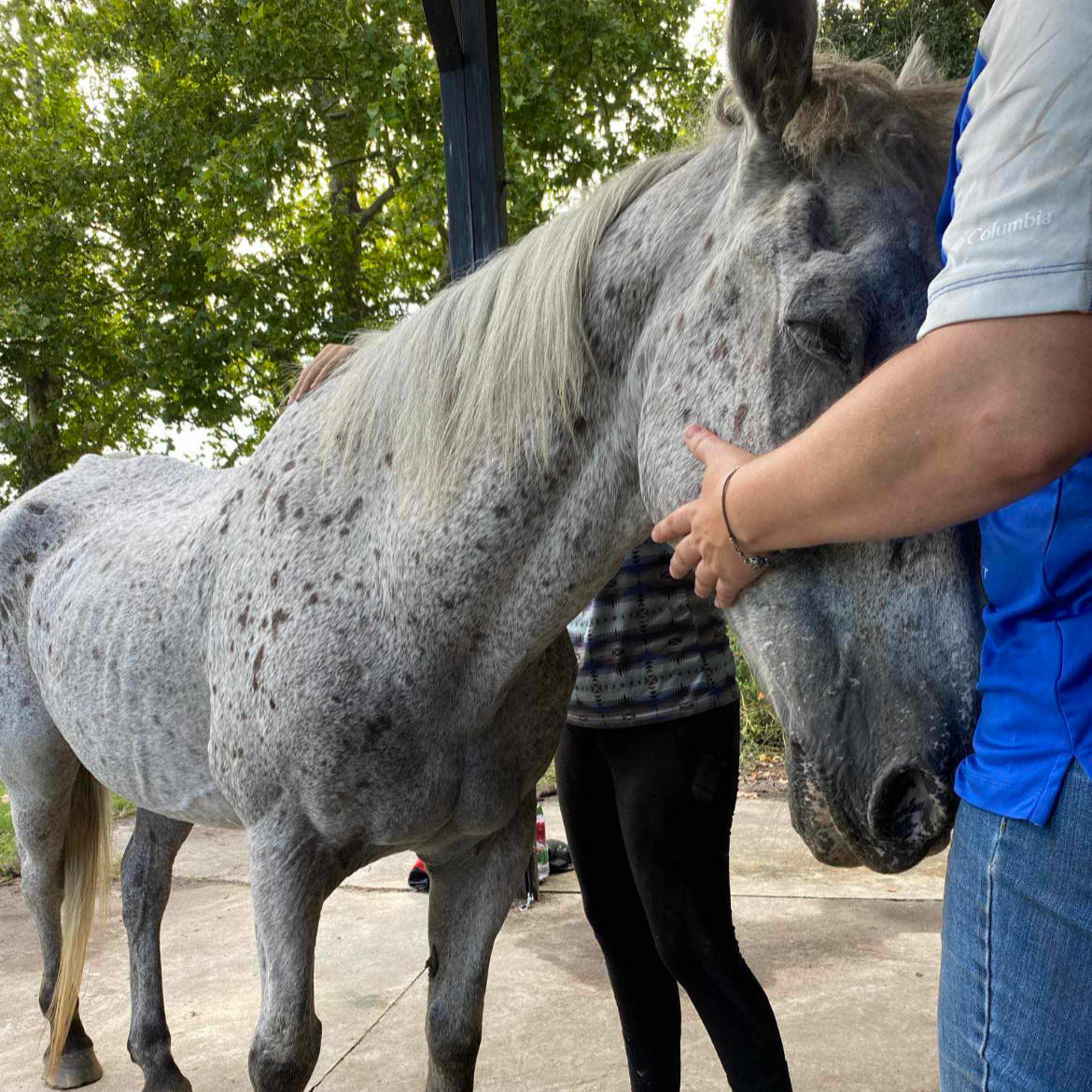
The Horse Labeled “Difficult” May Be Asking for Help
One of the things that breaks my heart in the horse world is how quickly horses are labeled.
Difficult.
Naughty.
Stubborn.
Dramatic.
Overreactive.
Lazy.
Hot.
Cold-backed.
Mare-ish.
Disrespectful.
I am not saying training does not matter. It does.
I am not saying horses never learn patterns. They do.
But I am saying many horses are trying to communicate discomfort, fear, confusion, or dysregulation long before they become “problem horses.”
By the time the behavior gets loud, the whisper was usually missed.
Energy work asks us to listen earlier.
It asks us to notice the horse who cannot exhale.
The horse who cannot soften.
The horse who cannot stand still without scanning.
The horse who leaves their body when pressure increases.
The horse who braces before the saddle even comes out.
The horse who looks fine on paper but does not feel fine in the hand.
The horse who has had the vet, the saddle fitter, the farrier, the dentist, and the trainer, but still feels like there is another layer.
Sometimes that layer is energetic.
Sometimes it is emotional.
Sometimes it is nervous system-based.
Often, it is all three.
What an Equine Energy Healing Session Looks Like
Every practitioner works differently, but in my sessions, the horse leads the pace.
I may begin by observing the horse’s posture, breathing, expression, and general state. I look at how they stand, how they interact, where they hold tension, and whether they seem present or guarded.
I also pay attention to the owner’s concerns.
Some horses come in for emotional support after trauma, grief, illness, injury, or major life changes. Others come in because they are anxious, reactive, shut down, hard to connect with, or struggling to relax.
Some owners simply feel like their horse needs support, even if they cannot explain why.
That intuitive knowing matters too.
During the session, I may work hands-on, hands-off, or from a distance depending on what the horse prefers. Some horses want contact. Some do not. Some need space before they trust the work.
I may incorporate Reiki, intuitive listening, nervous system support, breath awareness, and body-based observation.
Because of my background, I am often also noticing physical patterns, such as tension through the jaw, poll, neck, sternum, ribs, diaphragm, back, or pelvis.
But I do not force interpretation onto the horse.
The goal is not to diagnose.
The goal is to listen.
After the session, I may share what I observed, what areas seemed to draw attention, how the horse responded, and what the owner may want to continue noticing.
Sometimes sessions are peaceful.
Sometimes they are emotional.
Sometimes they are subtle.
Sometimes they are surprisingly profound.
But the heart of the work is always the same:
Create space for the horse’s system to feel heard.
Distance Reiki for Horses
One of the parts of Reiki that challenged my logical brain the most was distance work.
Hands-on energy work felt easier to accept at first because I could connect it to touch, presence, body language, and co-regulation.
Distance Reiki felt harder for me to wrap my mind around.
But again, the horses changed my mind.
Distance Reiki can be a beautiful option for horses who are sensitive, guarded, far away, recovering, or not ready for in-person work. It can also support horses during transitions, illness, end-of-life care, grief, travel, competition stress, or emotional processing.
Some horses seem to respond deeply to distance work because there is no physical pressure and no expectation.
They can receive from their own space.
For some horses, that matters.
I do not ask people to believe in distance Reiki blindly. I simply invite them to observe.
How does the horse behave during the session window?
Do they rest?
Do they yawn?
Do they shift?
Do they become quieter?
Does anything change in the hours or days after?
Observation is everything.
Again, the horse gets to tell us.
Why I Created My Equine Reiki Certification Course
After seeing how deeply this work affected horses, I knew I wanted to teach it in a way that felt grounded, ethical, and accessible.
That is why I created my Equine Reiki Certification course.
I did not want to create a course that made people feel like they had to abandon science to practice Reiki.
And I did not want to teach energy work in a way that ignored the horse’s body, behavior, nervous system, or consent.
My goal was to create an equine Reiki course for people who love horses and want to support them more deeply, whether they are horse owners, bodyworkers, trainers, wellness practitioners, or simply people who feel called to this work.
Inside the course, we explore Reiki as both a spiritual and practical tool.
We talk about the energetic body, but we also talk about observation, consent, nervous system regulation, emotional safety, and ethical boundaries.
Because energy work with horses is not about proving how intuitive we are.
It is about becoming safe enough, quiet enough, and clear enough for the horse to participate.
That matters to me.
I believe the horse world needs more people who can hold both sides:
The science and the spirit.
The anatomy and the intuition.
The nervous system and the soul.
The physical body and the energy body.
That is the kind of practitioner I needed when I was first exploring this work.
So that is the kind of training I wanted to create.
Signs Your Horse May Benefit From Energy Balancing
Equine energy healing may be supportive for many different types of horses.
Some signs your horse may benefit from Reiki or energy balancing include:
Your horse has anxiety or spookiness that seems difficult to shift
Your horse struggles to settle or relax
Your horse feels emotionally shut down or disconnected
Your horse has been through trauma, injury, illness, loss, or a major transition
Your horse carries chronic tension in the jaw, poll, neck, ribs, diaphragm, belly, or back
Your horse has difficulty softening even with appropriate training and care
Your horse becomes reactive around touch, tack, pressure, or handling
Your horse seems to hold stress in the body
Your horse is aging, transitioning, grieving, or nearing end of life
Your horse is in a rehabilitation process and needs emotional support
Your horse simply feels “off” and you sense there is another layer
Of course, energy work should not be used to avoid proper veterinary evaluation. If your horse is in pain, lame, sick, unsafe, or showing sudden behavioral changes, those concerns should be addressed appropriately.
But once the physical needs are being considered, energy work can be a powerful part of the support system.
What I Wish More People Understood About Reiki for Horses
I wish more people understood that Reiki is not about being dramatic.
It is not about claiming to magically cure horses.
It is not about bypassing veterinary medicine.
It is not about making everything mystical for the sake of sounding special.
At its best, equine Reiki is quiet.
It is respectful.
It is consent-based.
It is nervous-system aware.
It gives the horse room to be more than a body being managed.
It gives the horse space to be heard.
And it gives the human a chance to slow down enough to actually listen.
Sometimes that is the most healing thing we can offer.
The Horses Changed My Mind
I did not come into this work because I wanted to believe in something.
I came into it because the horses kept showing me there was more.
Dusty showed me that.
So did many horses after him.
The horses who softened before I touched them.
The horses who released when I stopped trying so hard.
The horses who communicated things I could not logically explain at the time.
The horses who responded to distance work.
The horses who carried emotional patterns in their bodies.
The horses who taught me that the nervous system is often the missing piece.
The horses who reminded me that the body, mind, and energy are not separate.
I am still logical.
I still care deeply about anatomy, biomechanics, bit fit, bodywork, and physical function.
But I am no longer willing to ignore the energetic and emotional layers just because they are harder to measure.
The horses deserve better than that.
They deserve practitioners who are curious enough to keep learning.
They deserve owners who are willing to listen differently.
They deserve care that honors the whole horse.
Not just the muscles.
Not just the movement.
Not just the behavior.
The whole horse.
Body, nervous system, energy, and spirit.
Final Thoughts: Energy Healing as Whole-Horse Care
Equine energy healing is not about choosing between science and intuition.
It is about recognizing that horses are complex, sensitive, intelligent beings who experience the world through their bodies, emotions, nervous systems, and energy.
My path into this work started with skepticism.
It grew through experience.
And it became something I could no longer ignore because the horses kept responding.
Today, I offer equine Reiki and energy balancing as part of a whole-horse approach that honors both the physical and energetic body. My work is rooted in bodywork, bit fitting, nervous system awareness, and the belief that horses often communicate long before we fully understand what they are saying.
Our job is to listen.
Not with ego.
Not with force.
Not with the need to prove something.
But with presence, humility, and respect.
Because sometimes the horse labeled difficult is not difficult at all.
Sometimes they are dysregulated.
Sometimes they are guarded.
Sometimes they are carrying something deeper.
And sometimes, when we finally stop trying to fix them and start listening to them, everything changes.
Work With Me
If your horse feels anxious, shut down, reactive, emotionally stuck, or like there may be another layer beneath the physical symptoms, equine energy healing may be a supportive piece of their care.
I offer equine Reiki, energy balancing, and whole-horse support through Spotted Horse LLC, blending bodywork, bit fitting, nervous system awareness, and intuitive energy work.
You can learn more or book a session through my website.
Learn Equine Reiki
If you feel called to support horses through energy work, I also offer an Equine Reiki Certification course designed for horse owners, equine professionals, bodyworkers, trainers, and intuitive practitioners.
This course blends traditional Reiki teachings with horse-centered ethics, nervous system awareness, consent, observation, and practical equine application.
You do not have to abandon logic to practice energy work.
You just have to be willing to listen differently.
