

Bit Breakdown: The Correction Port
So the correction port is a curb bit, which means it uses leverage to amplify pressure from the rider’s hands. A snaffle works on a 1:1 ratio, but a curb increases that pressure through the shank and curb strap—so what you feel in your hands is not what your horse feels in their mouth.
What makes a correction port different is the mouthpiece design.
Most of these bits include:
a higher port
multiple joints
a sharp 90 degree angle of the port
They’re often marketed as a more advanced or refined bit, something for a “finished” horse.
But to really understand them, you have to look at the mechanics, not the marketing.
When you pick up on a correction port, the mouthpiece doesn’t apply one steady, even pressure.
It rotates and shifts.
As it rotates:
the joints can collapse unevenly
the port can tip forward and up into the roof of the mouth
pressure can move from tongue to bars very quickly
in some ports, the bit may contact the palate
So instead of a consistent, predictable signal, your horse is feeling pressure that changes mid-aid.
That’s where things start to break down.
Horses learn through clarity. They need to understand where the pressure is, how to respond to it, and how to find the release. When the signal is constantly shifting, it becomes much harder for them to organize their body correctly.
This is when you’ll often see:
bracing through the jaw and underside of the neck
inconsistent contact
gaping or fussiness in the mouth
overflexion or avoidance
And a lot of times, that gets labeled as a training issue.
But often, it’s a communication issue.
Now let’s talk about the word “correction.”
Because most of the time, what we’re trying to “fix” isn’t actually happening in the mouth.
It’s usually:
a strength or balance issue
a lack of understanding in the training
or discomfort somewhere else in the body
When you introduce a bit with multiple pressure points and moving parts, you can create the appearance of control without actually addressing the root of the problem.
That doesn’t mean every horse goes poorly in a correction port. Some horses tolerate them just fine.
But tolerance isn’t the goal.
And just like with any curb bit, the curb strap matters.
I still recommend leather or biothane over chain. There are a lot of sensitive structures under the chin, and when you add a chain to a bit that already has a lot going on in the mouth, you’re stacking pressure—chin, bars, tongue, and possibly palate—all at once.
That can lead to anticipation.
And when your horse starts anticipating pressure, they brace.
When they brace, they can’t soften.
And when they can’t soften, they can’t move correctly through their body.
This is where bit fitting and bodywork really start to overlap.
If the jaw, tongue, and hyoid can’t move freely, it affects the entire ventral chain—down through the neck, into the shoulder, and even into overall posture and movement.
So the bit isn’t just a mouth issue.
It’s a whole horse issue.
My philosophy always comes back to the same thing:
comfort over compliance.
Yes, a correction port can create a quick response.
But when a horse is truly comfortable, physically capable, and mentally relaxed, they don’t need to be forced into a shape.
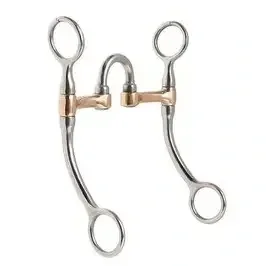
photo of a the most common bit when we say correction port
Curious about your horses bit? I offer in person sessions in SC and GA and virtual bit fittings world wide.
