

Understanding the Equine Chakras: An Energetic Map of the Horse’s Body
Energy work with horses isn’t about forcing healing or fixing what we think is broken. At its core, it’s about listening, observing, and creating space for the horse’s system to rebalance itself.
One framework often used in energy medicine is the chakra system.
Chakras are commonly described as energy centers that relate to physical structures, emotional themes, and patterns of movement within the body. While the chakra system originated in human traditions, many practitioners have found meaningful parallels when observing horses through an energetic lens.
Rather than viewing chakras as rigid or mystical, it can be more helpful to think of them as areas where the nervous system, fascia, and energetic body tend to intersect.
They offer a simple map.
Not a diagnosis tool.
Not a replacement for veterinary care.
Not a promise of instant healing.
Just another way to understand how stress, tension, and regulation may show up in the whole horse.
Root Chakra (Base of Spine / Pelvis)
The root chakra is often associated with safety, survival, and physical stability. In horses, this can relate to how grounded they feel in their body and environment. A horse that struggles with anxiety, startle responses, difficulty standing still, or inconsistent hind-end engagement may be experiencing challenges in this area.
From a physical standpoint, this region overlaps with the pelvis, sacrum, and large muscle groups responsible for propulsion. Supporting relaxation here through bodywork, gentle movement, and calm handling can help the horse feel more secure and organized.
Sacral Chakra (Lower Abdomen / Hips)
This center is commonly linked to fluidity, emotional expression, and adaptability. In horses, it may correlate with ease of movement through the back and hips, as well as their willingness to engage and interact.
Tightness in the lumbar region, reluctance to bend, or resistance to transitions can sometimes coincide with imbalance here. Supporting this area isn’t about “opening” anything forcefully. It’s about reducing guarding and allowing the body to soften.
Solar Plexus Chakra (Upper Abdomen / Diaphragm Area)
The solar plexus is often associated with personal power, boundaries, and confidence. For horses, this can look like how they handle pressure, expectations, and workload.
Physically, this region overlaps with the diaphragm, rib cage, and organs involved in digestion. Stress in this area is commonly connected to ulcers, shallow breathing, and a tight barrel. Supporting relaxation of the rib cage and encouraging slower breathing can have wide-reaching effects.
Heart Chakra (Chest / Thoracic Region)
The heart chakra is frequently associated with connection, trust, and emotional balance. In horses, this may relate to their ability to bond, settle, and feel safe with people and herd mates.
From a body perspective, this area includes the sternum, shoulders, and upper thoracic spine. Restrictions here can influence stride length, posture, and overall suppleness. Gentle bodywork and calm presence can support softening in this region.
Throat Chakra (Throat / Jaw / Poll)
This center is associated with communication and expression. In horses, it often ties closely to the mouth, jaw, tongue, hyoid apparatus, and poll.
Chronic tension here may show up as resistance to the bit, difficulty swallowing, head tossing, or a rigid neck. Because of the fascial connections between the jaw, hyoid, and forelimbs, imbalance in this area can affect far more than just the head and neck.
Thoughtful bit fitting, dental care, and gentle bodywork can play an important role in supporting this region.
Third Eye Chakra (Forehead / Between Eyes)
Often linked to perception and awareness, this center in horses can be viewed as their sensitivity to environment, energy, and subtle cues.
Some horses are naturally more perceptive and reactive. This is not a flaw. It’s a nervous system trait. Supporting these horses is less about changing who they are and more about helping them feel safe in their sensitivity.
Crown Chakra (Top of Head)
The crown chakra is associated with overall integration and connection. In horses, it can be thought of as the balance between body, mind, and environment.
When the system is regulated, energy flows more evenly. When stress accumulates, the system adapts around protection.
Chakras Are Not Separate from the Physical Body
One of the most important things to understand is that chakras are not floating concepts separate from anatomy. They overlap with nerve plexuses, fascial lines, organs, and major joints.
This is why combining energy work with bodywork, proper tack fit, appropriate nutrition, and good management matters.
Energy work alone is not a cure-all.
Bodywork alone is not a cure-all.
Training alone is not a cure-all.
Horses thrive when their care is approached as a system.
A Gentle Perspective
You do not need to “see” chakras.
You do not need to feel dramatic sensations.
You do not need to label every response.
Sometimes energy work looks like stillness.
Sometimes it looks like a sigh.
Sometimes it looks like nothing at all.
The goal is not to fix the horse.
The goal is to offer support and let the horse’s body choose what to do with it.
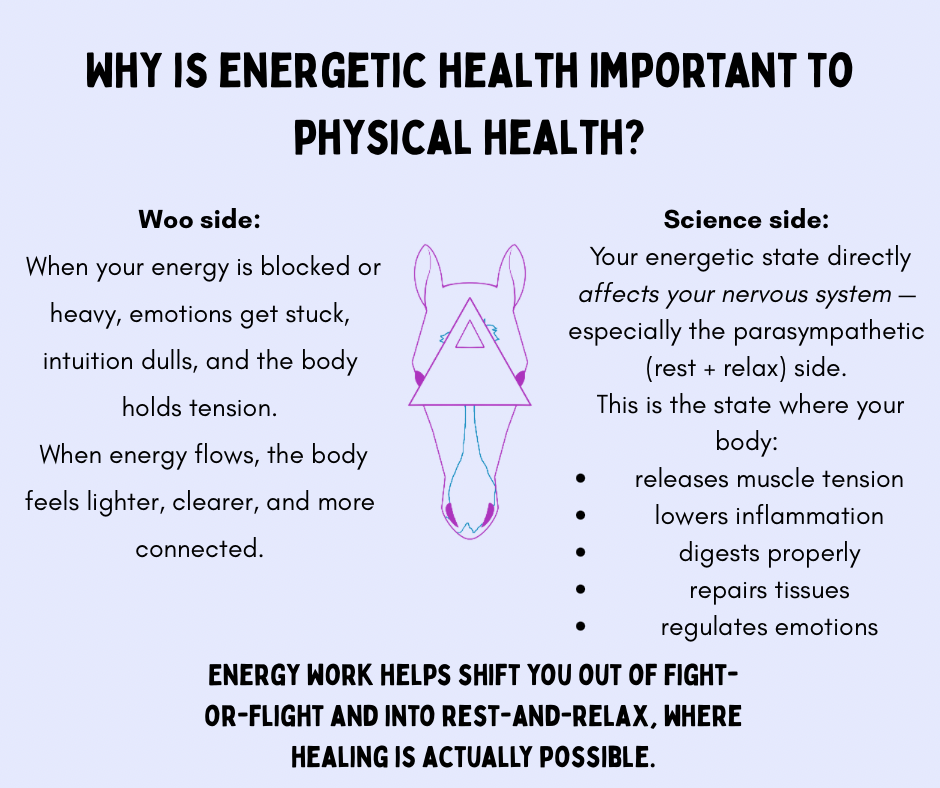
Why is energetic health important to physical health?
